 Add to Chrome
 Add to Firefox
 Add to Edge
SafeRx-Agent: A Knowledge-Grounded Multi-Agent Framework for Safe and Explainable Medication Recommendation
May 27, 2026
Medication recommendation predicts medications for patient visits, but existing methods still face two key challenges. At the model level, traditional drug recommendation methods only predict structured drug codes with limited evidence grounding, while LLM agents can use richer clinical context but may lack safety verification and traceability. At the task level, existing benchmarks often use broad medication categories, which ignore subgroup-level safety differences and can lead to risk overestimation. We introduce the first fine-grained medication recommendation setting based on fourth-level ATC code generation. We propose Safe Prescription Agent (SafeRx-Agent), a knowledge-grounded multi-agent framework that uses patient context, external clinical knowledge, and safety verification to recommend traceable medication sets. Experimental results on MIMIC-III and MIMIC-IV datasets show that SafeRx-Agent improves fine-grained medication prediction accuracy while controlling drug interactions, contraindications, and medication set size.

Ω-QVLA: Robust Quantization for Vision-Language-Action Models via Composite Rotation and Per-step Scaling
May 27, 2026Vision-Language-Action (VLA) models unify perception, reasoning, and control within a single policy, yet their multi-billion-parameter backbones and diffusion-based action heads make on-device deployment prohibitively expensive. Prior quantization efforts offer only partial solutions, compressing the LLM backbone while leaving the DiT action head at full precision, or resorting to mixed-precision schemes, driven by the belief that uniformly quantizing the action head is inherently unstable. We challenge this assumption with Omega-QVLA, the first training-free post-training quantization framework that compresses both the language backbone and the entire diffusion action head of a VLA model to a uniform W4A4 precision, eliminating the need for mixed-precision allocation. Omega-QVLA combines a composite SVD-Hadamard rotation that equalizes per-channel weight energy while diffusing residual activation outliers with per-step DiT activation scaling quantization that absorbs dynamic-range drift across denoising steps. On LIBERO, Omega-QVLA compresses Pi 0.5 and GR00T N1.5 to W4A4 with 98.0% and 87.8% task success rates, matching or exceeding their FP16 references of 97.1% and 87.0%, while reducing the static memory footprint by 71.3%. Real-world manipulation experiments further confirm smooth, accurate manipulation where prior methods fail. Code is available at https://github.com/UCMP13753/Omega-QVLA.
Beyond Hard Writes and Rigid Preservation: Soft Recursive Least-Squares for Lifelong LLM Editing
Jan 22, 2026Model editing updates a pre-trained LLM with new facts or rules without re-training, while preserving unrelated behavior. In real deployment, edits arrive as long streams, and existing editors often face a plasticity-stability dilemma: locate-then-edit "hard writes" can accumulate interference over time, while null-space-style "hard preservation" preserves only what is explicitly constrained, so past edits can be overwritten and unconstrained behaviors may deviate, degrading general capabilities in the many-edits regime. We propose RLSEdit, a recursive least-squares editor for long sequential editing. RLSEdit formulates editing as an online quadratic optimization with soft constraints, minimizing a cumulative key-value fitting objective with two regularizers that control for both deviation from the pre-trained weights and from a designated anchor mapping. The resulting update admits an efficient online recursion via the Woodbury identity, with per-edit cost independent of history length and scaling only with the current edit size. We further provide deviation bounds and an asymptotic characterization of the adherence-preservation trade-off in the many-edits regime. Experiments on multiple model families demonstrate stable scaling to 10K edits, outperforming strong baselines in both edit success and holistic stability -- crucially retaining early edits, and preserving general capabilities on GLUE and held-out reasoning/code benchmarks.
SNAP: Stopping Catastrophic Forgetting in Hebbian Learning with Sigmoidal Neuronal Adaptive Plasticity
Oct 20, 2024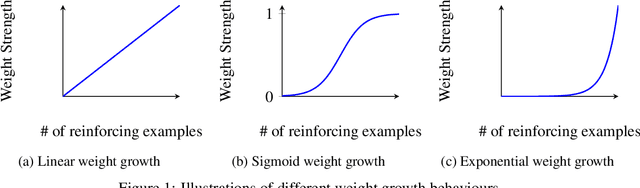

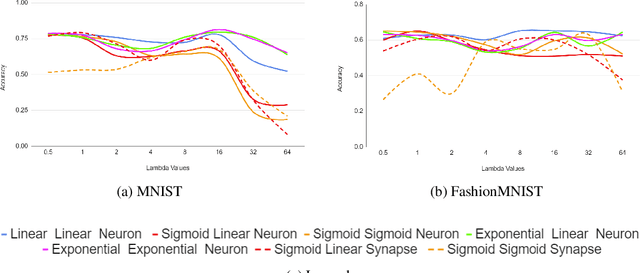
Artificial Neural Networks (ANNs) suffer from catastrophic forgetting, where the learning of new tasks causes the catastrophic forgetting of old tasks. Existing Machine Learning (ML) algorithms, including those using Stochastic Gradient Descent (SGD) and Hebbian Learning typically update their weights linearly with experience i.e., independently of their current strength. This contrasts with biological neurons, which at intermediate strengths are very plastic, but consolidate with Long-Term Potentiation (LTP) once they reach a certain strength. We hypothesize this mechanism might help mitigate catastrophic forgetting. We introduce Sigmoidal Neuronal Adaptive Plasticity (SNAP) an artificial approximation to Long-Term Potentiation for ANNs by having the weights follow a sigmoidal growth behaviour allowing the weights to consolidate and stabilize when they reach sufficiently large or small values. We then compare SNAP to linear weight growth and exponential weight growth and see that SNAP completely prevents the forgetting of previous tasks for Hebbian Learning but not for SGD-base learning.